



Shopping for a ring with real history is a different experience than browsing a case of new inventory, and nowhere is that more true than with Art deco engagement rings. These pieces, produced roughly between the 1920s and mid-1930s, have earned a devoted following among couples and collectors who want a ring that carries genuine craftsmanship rather than a modern imitation of a vintage look. But with popularity comes a flooded market of reproductions, which makes knowing what to look for essential before making a purchase.
The first thing to understand is what actually defines the era. Art Deco jewelry emerged during a period of design that favored bold geometry over the softer, romantic curves of earlier decades. Rings from this time typically feature symmetrical layouts, sharp architectural lines, and a level of precision that reflected the broader design movement happening in art and architecture at the time. Platinum became the metal of choice among fine jewelers during this era, prized for its strength and its ability to support delicate, intricate settings without added bulk.
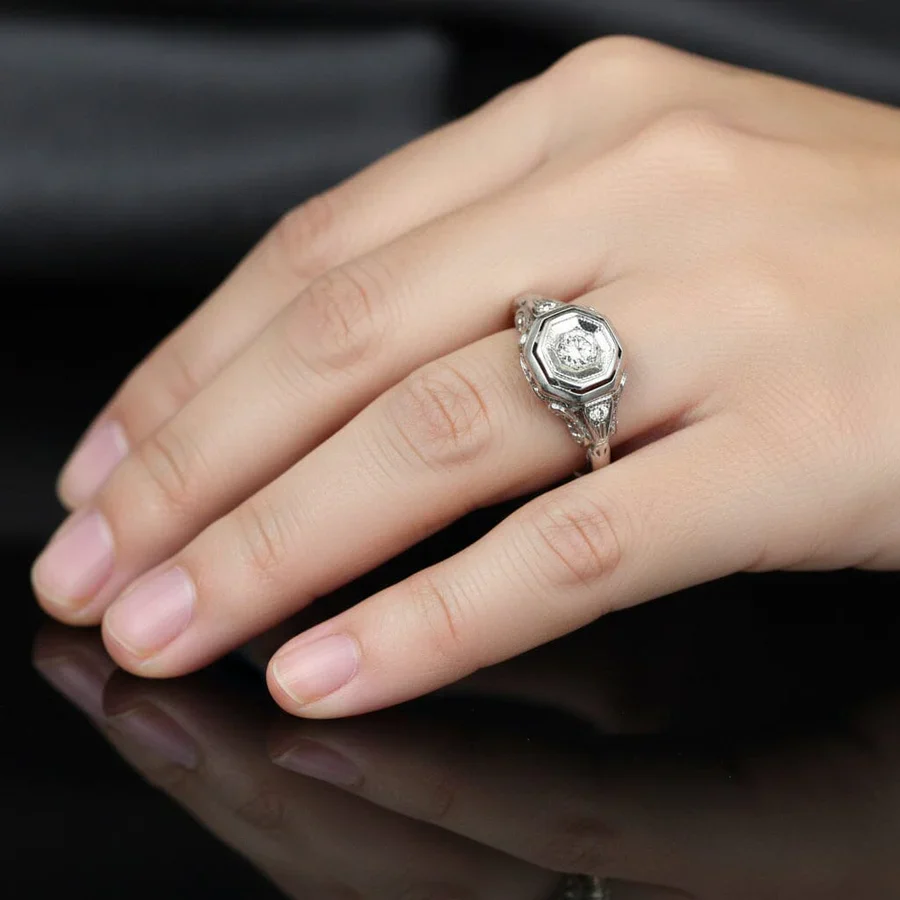
Authenticity starts with the details a reproduction usually cannot replicate convincingly. Genuine pieces from this period often feature old European cut or old mine cut diamonds, both of which have a distinct faceting pattern and a slightly higher crown compared to the modern round brilliant cuts most buyers are used to seeing. Filigree work, the delicate lacelike metal patterns achieved through hand engraving, should show the slight irregularities of hand craftsmanship rather than the too-perfect uniformity of machine work. Milgrain edging, the fine beaded detail along a setting’s border, is another marker worth examining closely, since it takes considerable skill to execute well and is often simplified or skipped in reproductions.
Documentation matters just as much as visual inspection. A reputable dealer should be able to provide information on a ring’s age, the origin and cut of its center and accent stones, and any restoration or repair work that has been performed over the decades. Buyers should ask directly whether a stone has been replaced or recut, since either can affect both the ring’s authenticity and its long-term value. A dealer who hesitates to answer these questions in detail is usually a sign to look elsewhere.
Condition assessment is the next practical step. Prongs on antique settings can wear thin after decades of daily use, so a jeweler should inspect them for structural soundness before any purchase is finalized. Filigree, while beautiful, is also more delicate than a solid modern band, and any hairline cracks or previous repairs should be disclosed upfront. Buyers planning to wear the ring daily, rather than display it, should ask specifically about durability for everyday use, since some more delicate antique settings benefit from a reinforced band or protective styling.
Sizing deserves particular attention with rings from this era. Resizing an Art Deco ring is often more complicated than resizing a modern band, since the filigree and engraving can run close to the shank and may be disrupted by significant size changes. Working with a jeweler experienced specifically in antique pieces, rather than a general resizing service, helps avoid damage to details that cannot easily be restored.
For collectors and gift buyers, all of this diligence pays off in more than aesthetics. A properly authenticated Art Deco ring tends to hold its value well, reflecting both its rarity and the craftsmanship that went into producing it nearly a century ago. Beyond the financial case, there is something genuinely meaningful about a ring that has already outlasted generations before beginning its next chapter with a new owner.
Buyers who want confidence in both authenticity and craftsmanship can explore a fully documented selection at Gesner Estate Jewelry, where every piece comes with the provenance and detail serious collectors and engagement shoppers expect.